


 English
  Español
 русский
News
Content
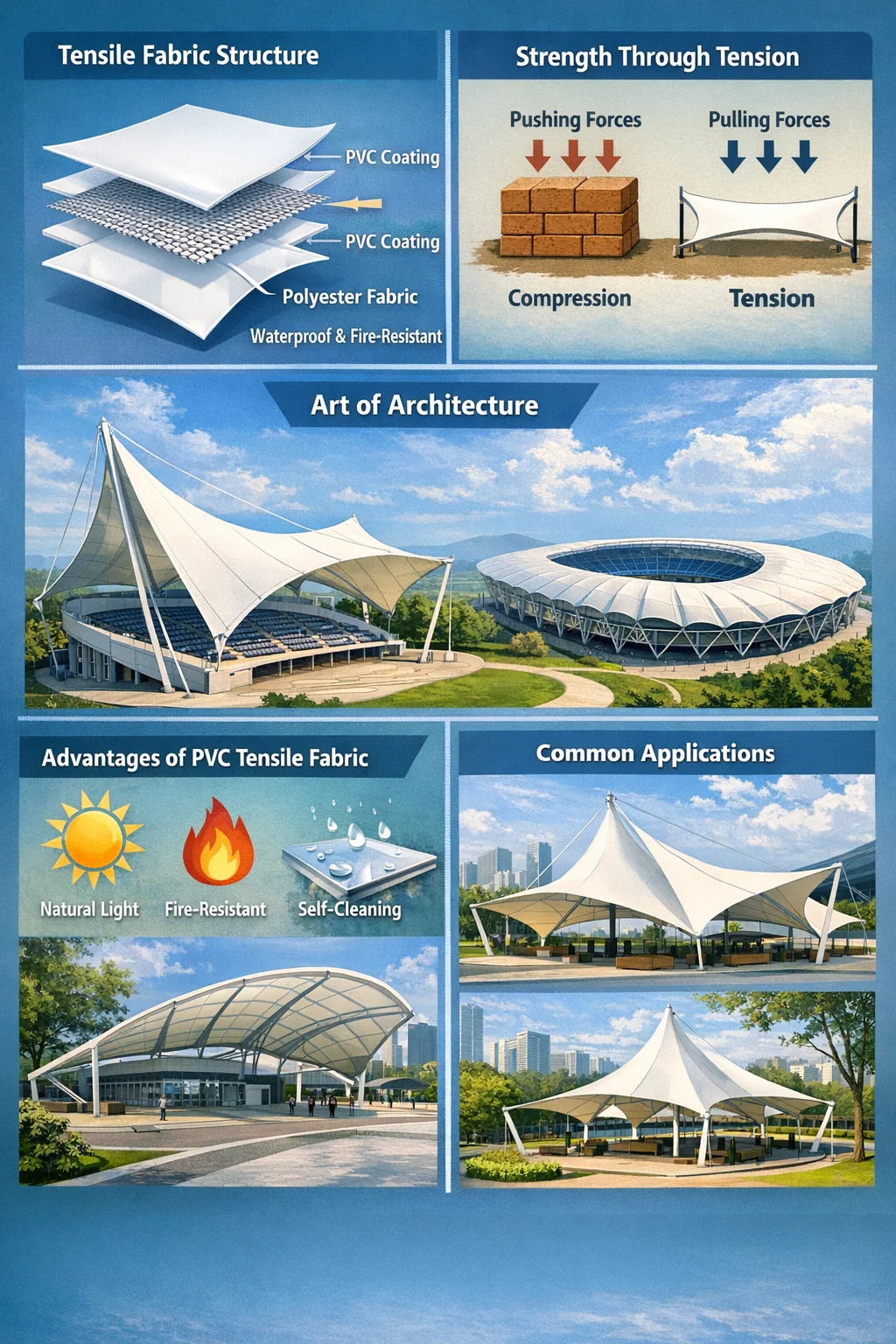
Tensile fabric is a special type of flexible fabric that is "capable of bearing stress and weight." Unlike ordinary clothing or curtains that hang loosely, it must be "stretched tightly" using steel cables, supports, or air pressure to form a rigid yet lightweight curved surface.
The most common example of this material is PVC tensile fabric. You can think of it as the "skin" of a building.
1. Its core characteristic: It works by "tension."
Ordinary building materials (such as bricks and wood) support themselves by resisting compression, while tensile fabric is the opposite.
Strength through tension: Just like a kite or a drumhead, it only becomes as strong as a solid panel when it is stretched tightly enough.
Strength through flexibility: Despite its thinness, the stretched membrane can withstand strong winds and even heavy snow, and it won't shake apart in strong winds like ordinary awnings.
2. What does it look like? (Structural composition)
This material is not a single layer of plastic; it's more like a "composite sandwich."
Tough inner core: Inside is a densely woven industrial fabric (usually polyester fiber), which is its "skeleton," determining how much tension it can withstand.
Versatile coating: Both sides of the fabric are evenly coated with a PVC layer, which is what we call PVC coated fabric technology. This "adhesive" makes the fabric waterproof, fire-resistant, and protects the inner fibers from sun damage.
3. Why is it called the "artwork of the architectural world"?
Because this material must be stretched to be used, it naturally forms many beautiful geometric shapes.
Streamlined appearance: It can create curved shapes like saddles, waves, and tents. This aesthetic is difficult to replicate with reinforced concrete.
Lightweight and transparent: It can cover extremely large areas (such as an entire stadium grandstand), but it doesn't require dense columns underneath, providing an excellent sense of space.
4. What are the outstanding advantages of this material?
No need for lights during the day: PVC tensile fabric has a certain degree of light transmission; sunlight is filtered into soft, diffused light, making the interior very bright.
Fire-resistant and durable: Modern membrane materials are specially treated to self-extinguish after the fire source is removed, and they are mildew-proof and corrosion-resistant, lasting for decades outdoors even with exposure to wind and sun.
Self-cleaning: Its surface usually has an extremely smooth film. When it rains, the rainwater can wash away the dust, making the building always look brand new.
5. Where is it commonly seen?
Large venues: Stadium grandstand roofs, train station entrance canopies.
Small landscapes: Uniquely shaped pavilions in parks, parking sheds in high-end communities, and open-air canopies in commercial streets.
 Previous


