


 English
  Español
 русский
News
Content
- 1 What Projector Screens Are Actually Made Of
- 2 PVC Coated Fabrics: The Most Widely Used Projector Screen Material
- 3 Base Fabric Options: Polyester vs. Fiberglass vs. Woven Cloth
- 4 Screen Gain and How Material Composition Controls It
- 5 Optical Films and Rigid Substrates: Beyond PVC Coated Fabrics
- 6 Outdoor Projector Screen Materials: Durability Requirements
- 7 Retractable Screen Mechanisms and Material Requirements
- 8 How to Identify Quality PVC Coated Fabric in a Projector Screen
- 9 Caring for PVC Coated Projector Screen Fabric
- 10 Choosing the Right Screen Material for Your Projection Setup
What Projector Screens Are Actually Made Of
The short answer: most projector screens are made from PVC coated fabrics — a woven polyester or fiberglass base fabric that is coated or laminated with one or more layers of polyvinyl chloride (PVC) compound, then finished with a specialized optical surface treatment. This combination gives the screen its structural integrity, its reflective or gain properties, and its resistance to wrinkles, moisture, and mildew.
Beyond PVC coated fabrics, manufacturers also use optical-grade vinyl, matte white films, gray-tinted layers, acrylic-coated textiles, and in premium segments, micro-perforated or woven materials that allow audio to pass through. The exact composition depends heavily on the screen's intended use — home theater, commercial presentation, outdoor cinema, or professional staging.
Understanding what a projector screen is made of matters because the material directly controls image brightness, color accuracy, contrast ratio, viewing angle, and ambient light rejection. Choosing the wrong surface material for your environment is one of the most common reasons people are disappointed with their projection setup — even when the projector itself is high quality.
PVC Coated Fabrics: The Most Widely Used Projector Screen Material
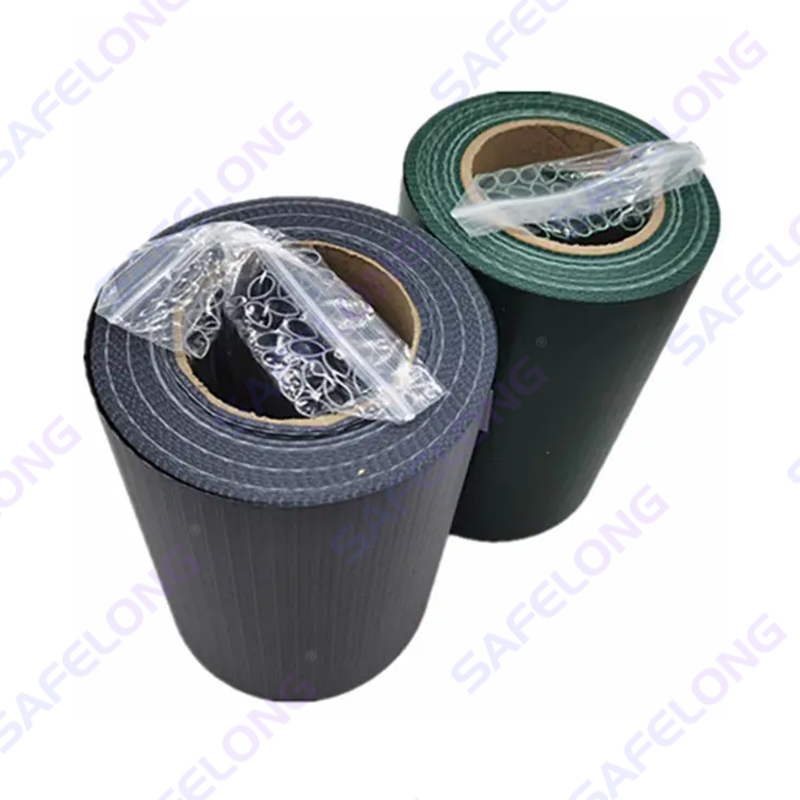
PVC coated fabrics dominate the projector screen market for very practical reasons. The manufacturing process begins with a base textile — typically a tightly woven polyester mesh with a thread count ranging from 100 to 300 per inch depending on quality tier — which is then knife-coated or calendar-laminated with a PVC compound. The PVC layer fills the gaps between threads, creating a continuous, non-porous surface that can be precision-finished.
The finished PVC coated fabric for projection screens typically falls between 300 gsm and 550 gsm (grams per square meter) in weight. Lighter weights around 300–350 gsm are used for portable and retractable screens, while heavier 450–550 gsm coated fabrics are found in fixed-frame and outdoor cinema screens where rigidity and weather resistance are priorities.
How the Coating Process Works
During production, the PVC compound — which includes plasticizers, stabilizers, and pigments — is applied to both sides of the base fabric in multiple passes. The front face receives an optical topcoat that determines gain value and viewing angle. Common topcoat formulations include:
- Barium sulfate-based white coatings for standard matte white screens (gain values typically 1.0–1.3)
- Titanium dioxide pigmented coatings for high-gain surfaces (gain values 1.5–2.5)
- Gray-tinted PVC compounds for ambient light rejection (ALR) screens, which improve perceived contrast by 30–50% in lit rooms
- Retroreflective micro-bead coatings for ultra-short throw (UST) projector screens
The back side of the PVC coated fabric usually receives a black backing coat, which prevents light bleed-through and adds opacity. This is especially important for screens used in environments where some light may come from behind the screen surface.
Flame Retardancy and Safety Standards
Commercial and large-venue PVC coated fabrics used in projection screens are typically required to meet fire safety certifications. In the United States, this means compliance with NFPA 701 (Standard Methods of Fire Tests for Flame Propagation of Textiles and Films). In Europe, the equivalent standard is EN 13501. Premium screen materials from manufacturers like Da-Lite, Draper, and Stewart Filmscreen routinely certify their PVC coated fabrics to these standards. This is non-negotiable for screens installed in cinemas, auditoriums, and conference centers.
Base Fabric Options: Polyester vs. Fiberglass vs. Woven Cloth
The base substrate beneath the PVC coating varies by application and price point. Each substrate has different mechanical and optical properties that carry through to the finished screen surface.
| Base Fabric | Typical Use | Key Advantage | Key Limitation |
|---|---|---|---|
| Woven Polyester | Portable, retractable, home use | Lightweight, flexible, low cost | Can stretch over time |
| Woven Fiberglass | Fixed-frame, commercial, cinema | Dimensionally stable, flat surface | Heavier, more expensive |
| Knitted Polyester | Curved screens, tension systems | Stretches evenly under tension | Less rigid than woven |
| Microperforated PVC | Cinema with front speakers | Acoustically transparent | Visible perforation pattern possible |
Fiberglass-based PVC coated fabrics are considered the gold standard for fixed-frame home theater and commercial cinema installations. The fiberglass weave resists thermal expansion and contraction, which means the screen stays perfectly flat even with temperature fluctuations — a critical factor for 4K and 8K projection where even minor surface undulation can defocus the image.
Screen Gain and How Material Composition Controls It
Screen gain is a measurement of how much light a screen reflects relative to a standard white reference (magnesium carbonate, assigned a gain of 1.0). The material composition of the PVC coated fabric — specifically its topcoat formulation and surface texture — is the primary determinant of gain value.
- Matte white PVC screens (gain 0.9–1.3): These use a flat, diffuse white topcoat. They scatter light evenly in all directions, producing wide viewing angles of 160–180 degrees. Best for rooms with controlled lighting and multiple seating positions.
- High-gain PVC screens (gain 1.5–3.0): Achieved by incorporating glass bead coatings or highly reflective aluminum oxide particles into the PVC topcoat. These screens concentrate reflected light toward the center of the audience, boosting perceived brightness but narrowing the viewing cone to 60–100 degrees.
- Gray or silver PVC screens (gain 0.8–1.1): The gray pigment in the PVC compound absorbs ambient light more effectively than white, improving native contrast ratios. Suitable for living rooms and environments where blackout curtains are impractical.
- ALR (Ambient Light Rejecting) screens: These use specially structured PVC coated fabrics with micro-layered optical coatings or lenticular surfaces that reject off-axis ambient light while reflecting on-axis projector light. Effective ambient light rejection can improve contrast in bright rooms by a factor of 3x–5x.
A key point many buyers miss: higher gain does not mean better image quality. High-gain PVC coated fabric screens often exhibit "hot spotting" — a bright central area with dimmer edges — which is visually distracting, especially for cinematic content. For most home theater applications with a projector producing 2,000–3,500 lumens, a gain of 1.0–1.3 is ideal.
Optical Films and Rigid Substrates: Beyond PVC Coated Fabrics
While PVC coated fabrics are the backbone of most projector screens, certain high-end and specialized screens use different base materials entirely.
Optical-Grade Vinyl Films
Some premium portable screens and short-throw projection systems use optical-grade vinyl films without a textile backing. These are extruded PVC or polyester films with a controlled surface roughness specified in microns. The absence of a woven substrate eliminates the risk of "moire" patterns — interference fringes that can sometimes appear when the pixel grid of a projector interacts with the woven texture of a coated fabric screen. Optical films are thinner (typically 0.3–0.8 mm versus 0.6–1.2 mm for coated fabrics) but less durable in outdoor or high-traffic environments.
Rigid Acrylic and Aluminum Substrates
High-end fixed-frame and architectural screens sometimes use rigid substrates: either aluminum composite panels or acrylic sheets coated with an optical projection surface. These materials guarantee an absolutely flat surface — flatness tolerance of ±0.5 mm or better across the entire screen — which is essential for 4K laser projection in premium home cinema rooms. Stewart Filmscreen's Studiotek 130 and 100 products, for example, are applied to rigid substrates for their highest-tier installations.
Woven Acoustic Transparent Materials
For installations where speakers are placed behind the screen — standard practice in commercial cinemas and increasingly popular in dedicated home theaters — the screen fabric must be acoustically transparent. Two main approaches exist:
- Micro-perforated PVC coated fabric: Standard PVC screen material is mechanically perforated with thousands of tiny holes, typically 0.5–1.0 mm in diameter, spaced 2–3 mm apart. This allows sound waves to pass through while maintaining an optical surface. The perforation pattern typically reduces light output by 5–10%.
- Woven acoustic fabric: A more open weave — usually polyester or a polyester-spandex blend — is coated lightly enough to preserve gaps between threads. Brands like Seymour Screen Excellence and Screen Research specialize in these materials, which offer better acoustic transparency (sound transmission loss below 1 dB) but require higher projector brightness to compensate for the open weave's lower reflectivity.
Outdoor Projector Screen Materials: Durability Requirements
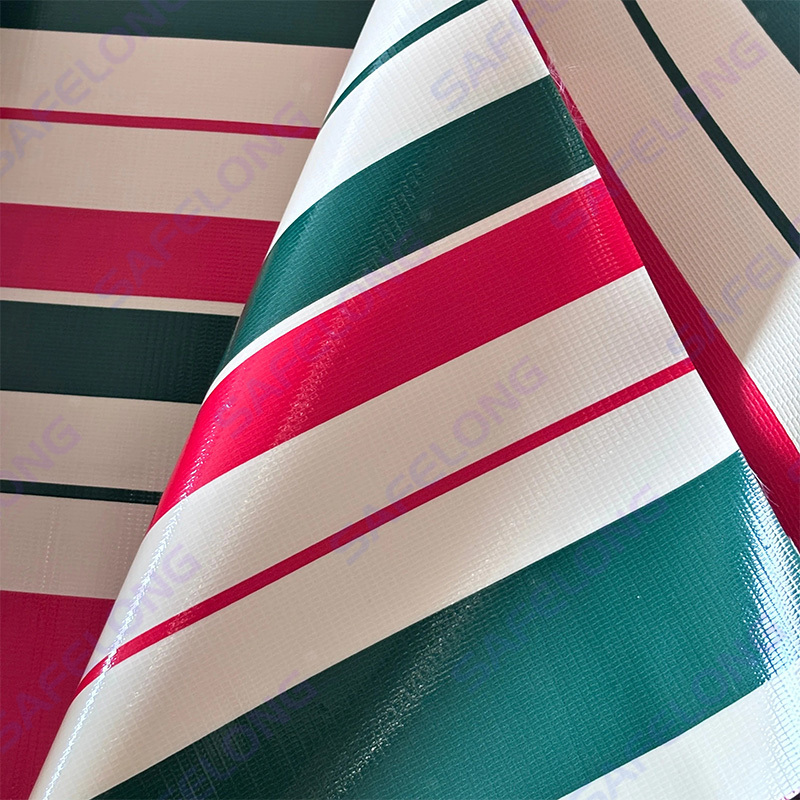
Outdoor projection screens face conditions that indoor screens never encounter: UV radiation, moisture, wind load, temperature swings, and physical abrasion. The PVC coated fabrics used in outdoor screens are specifically formulated to meet these demands.
Key differences in outdoor-grade PVC coated fabric for projection screens include:
- UV stabilizers in the PVC compound: Standard indoor PVC coated fabrics will yellow and become brittle within 12–18 months of direct sunlight exposure. Outdoor grades use UV-absorbing additives (typically benzotriazole or triazine compounds) that extend service life to 5–10 years outdoors.
- Higher tensile strength: Outdoor screens in inflatable or frame-tensioned configurations must withstand wind loads. Commercial outdoor screen fabrics typically have tensile strengths of 2,000–4,000 N/5cm (measured per EN ISO 1421), compared to 800–1,500 N/5cm for indoor retractable screen materials.
- Mildew resistance: PVC coated fabrics for outdoor screens incorporate antimicrobial additives to prevent mold and mildew growth, which can permanently stain the optical surface.
- Welded seams: Large outdoor screens (above 5 meters wide) are produced from multiple widths of PVC coated fabric joined by high-frequency or hot-air welding. This creates seams stronger than the base fabric itself, with peel strength exceeding 150 N/5cm.
For inflatable outdoor movie screens — popular for community events and drive-in setups — the screen surface is typically a separate PVC coated fabric panel tensioned within or attached to the inflatable frame structure. Screen surface weights of 400–500 gsm are standard for these applications.
Retractable Screen Mechanisms and Material Requirements
Retractable projector screens — both manual pull-down and motorized — place specific demands on the PVC coated fabric used for the screen surface. The material must roll and unroll tens of thousands of times without developing creases, and it must return to a perfectly flat position each time it is deployed.
To achieve this, retractable screen fabrics use PVC coated textiles with:
- Lower stiffness (flexural rigidity below 20 mN·m) so they roll cleanly around small-diameter spools — typically 25–50 mm in diameter for ceiling cassette screens
- High elastic recovery — the ability to return to flat dimensions after being rolled under spring tension for extended periods
- A black masking border (usually a separate PVC strip thermally welded to the edges) that provides the visual frame and prevents edge curl
- Tensioning systems at the bottom — bottom bars weighted with aluminum extrusions of 500–1,500 grams — that keep the surface under controlled downward tension to eliminate wave and ripple
Premium motorized retractable screens from brands like Elite Screens, Epson, and Draper use tab-tensioned systems where side cables run through sewn-in channels along the edges of the PVC coated fabric, maintaining lateral tension across the full width of the screen. This eliminates side curl on screens wider than 2 meters — a common problem on budget tab-free retractable models.
How to Identify Quality PVC Coated Fabric in a Projector Screen
Not all PVC coated fabrics used in projector screens are equal. Here are practical ways to evaluate screen material quality before purchasing:
Physical Inspection
- Hold the screen surface at a low angle to a light source. A quality PVC coated fabric should have a uniformly smooth, matte surface with no visible texture irregularities, pinholes, or coating voids.
- Check the edges: well-finished screens have clean, straight borders with no delamination between the PVC layer and the base fabric.
- Feel the reverse side: a proper black backing coat should be smooth and opaque, blocking all light when held up to a bright source.
Projection Test
- Project a full white field and look for brightness uniformity. Hot spotting (brighter center) on a supposedly 1.0 gain matte white screen indicates inconsistent coating thickness.
- Project a fine checkerboard pattern (1-pixel alternating black and white squares at native resolution). Any moire or shimmer suggests the PVC coated fabric's surface texture frequency is interfering with the pixel grid.
- Project a test image with a black background: the screen surface should appear uniformly neutral — any color tint (yellowing, blue shift) indicates low-quality pigments in the PVC compound.
Manufacturer Specifications to Look For
- Published gain value with measurement methodology (ANSI/ISO 9386-1 is the standard)
- Half-gain angle specification (the off-axis angle at which brightness falls to 50% of center)
- Fabric weight in gsm
- Fire rating certification (NFPA 701 or EN 13501 for commercial installations)
- Country of manufacturing and quality control standard (ISO 9001 certified production)
Caring for PVC Coated Projector Screen Fabric
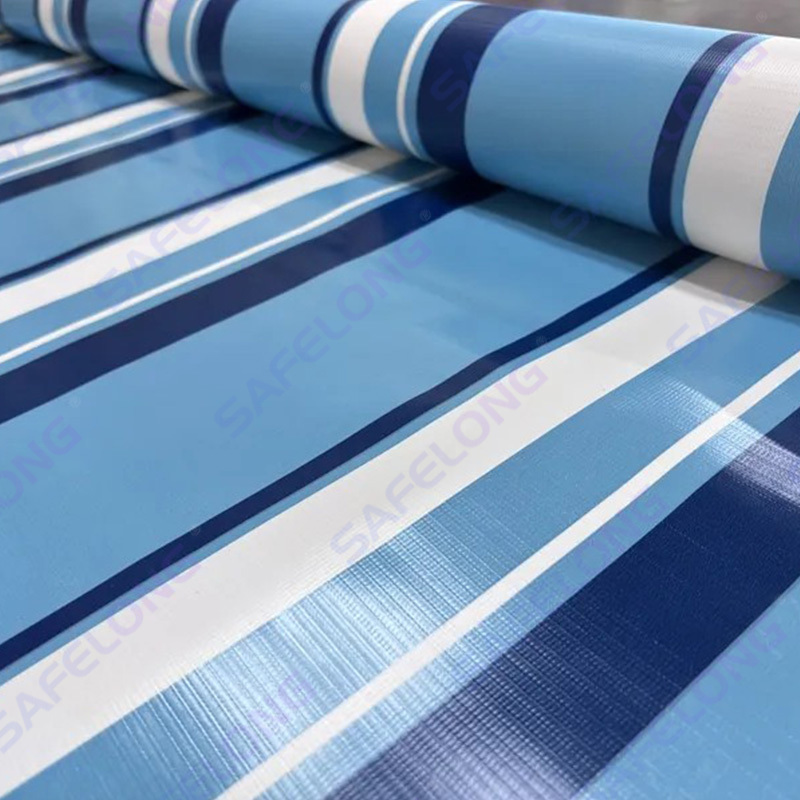
Despite being durable, PVC coated fabrics used in projector screens require careful maintenance to preserve their optical properties.
- Dust: Use a soft, dry microfiber cloth or a gentle air blower. Never wipe aggressively — the optical topcoat on PVC coated fabrics is susceptible to micro-scratching, which scatters light and reduces effective gain.
- Fingerprints and smudges: Lightly dampen a microfiber cloth with distilled water and dab (do not wipe) the affected area. For stubborn marks, a 1:10 dilution of mild dish soap in distilled water is safe for most PVC coated fabrics. Avoid alcohol-based cleaners as these can swell and cloud the PVC surface.
- Creases: If a retractable screen develops a crease, do not attempt to iron it. PVC softens at around 80–100°C — direct heat will permanently damage the coating. Instead, deploy the screen in a warm room (25–30°C) for 24–48 hours under tension, which allows the material to relax back to flat.
- Storage: When storing a portable screen, always roll the PVC coated fabric screen-side out around its own spool at low tension. Rolling it the wrong way puts the optical surface in compression, which can crack the coating over time.
With proper care, a high-quality PVC coated fabric projector screen should maintain its optical properties for 10–15 years in indoor use, making it a long-term investment rather than a consumable component of your projection system.
Choosing the Right Screen Material for Your Projection Setup
Matching the screen material to the projection environment is as important as choosing the right projector. Here is a practical guide based on common scenarios:
| Scenario | Recommended Material | Gain Target | Key Reason |
|---|---|---|---|
| Dark home theater | Matte white PVC coated fabric | 1.0–1.1 | Wide viewing angle, accurate color |
| Living room with windows | Gray ALR PVC coated fabric | 0.8–1.0 | Ambient light rejection improves contrast |
| Conference room presentation | Matte white PVC coated fabric | 1.0–1.3 | Wide viewing angle for many viewers |
| Ultra-short throw projector | UST ALR lenticular film or coated fabric | 0.6–0.8 | Rejects ceiling ambient light, accepts low-angle projector light |
| Outdoor movie night | UV-stable outdoor PVC coated fabric | 1.1–1.5 | Weather resistance and brightness in open air |
| Cinema with behind-screen audio | Micro-perforated PVC coated fabric | 0.9–1.1 | Acoustic transparency with projection performance |
One final consideration: the screen material must be matched not just to the room, but to the projector's native resolution and throw ratio. A 4K laser projector with a lens-shift ratio capable of filling a 150-inch screen deserves a fiberglass-based PVC coated fabric fixed-frame screen with sub-millimeter flatness tolerance. Pairing it with a budget polyester retractable screen introduces surface variation that negates much of the image quality advantage of the projector itself.
The screen is not a passive backdrop — it is an active optical component. The material it is made from is just as technically significant as the projector's lens system. Treating the screen selection with the same rigor as the projector selection is the single most impactful step most projection enthusiasts can take toward better image quality.
 Previous


