


 English
  Español
 русский
News
Content
- 1 The Short Answer: Tensile Fabric Handles Heat Well — But Material Choice Matters
- 2 How Heat Physically Affects Tensile Fabric Structures
- 3 PVC Tensile Fabric: Why It Dominates High-Heat Applications
- 4 Comparing Tensile Fabric Types by Heat Performance
- 5 Real-World Heat Scenarios and How PVC Tensile Fabric Responds
- 6 What the Fabric Weight and Grade Tell You About Heat Tolerance
- 7 Colour Selection and Its Significant Impact on Heat Performance
- 8 Fire Behaviour of PVC Tensile Fabric in Heat
- 9 Signs That Heat Has Damaged Your Tensile Fabric
- 10 Maintenance Practices That Preserve Heat Resistance Over Time
- 11 Specifying PVC Tensile Fabric for Heat-Exposed Projects: A Practical Checklist
The Short Answer: Tensile Fabric Handles Heat Well — But Material Choice Matters
Tensile fabric generally performs well in high-heat environments, but performance varies significantly depending on the base material. PVC tensile fabric is among the most heat-resistant options commercially available, routinely withstanding continuous temperatures of 70°C (158°F) and short-term exposure up to 90°C (194°F) without structural failure. Standard HDPE shade cloth, by contrast, begins to lose tensile strength above 50°C (122°F). If your installation is in a region with intense sun, high ambient temperatures, or direct radiant heat, the material specification you choose will determine whether the structure lasts five years or fifteen.
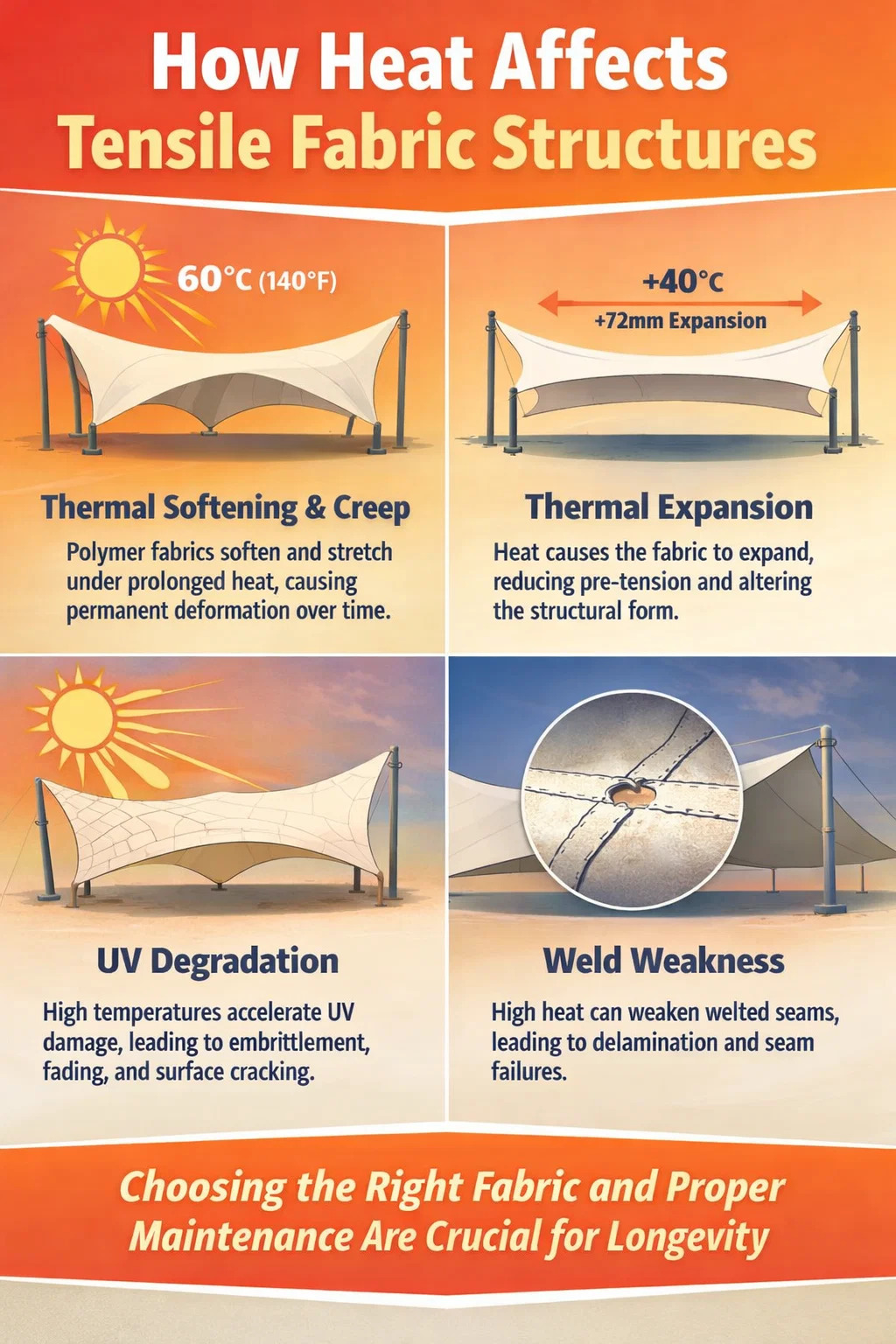
Heat affects tensile fabric in three distinct ways: it softens the material, accelerates UV degradation, and causes dimensional expansion that alters the pre-tension engineered into the structure. Understanding each of these mechanisms helps you select the right fabric and set realistic maintenance expectations.
How Heat Physically Affects Tensile Fabric Structures
When a tensile fabric membrane is exposed to high temperatures, three overlapping physical processes begin to occur simultaneously. Knowing these processes is not just academic — they directly inform how a structure should be designed, specified, and maintained.
Thermal Softening and Creep
All polymer-based tensile fabrics experience what engineers call "creep" — a slow, permanent deformation under sustained load and elevated temperature. For PVC tensile fabric coated over a polyester scrim, creep rates are extremely low at normal operating temperatures. Independent testing by membrane manufacturers such as Mehler Texnologies and Verseidag has shown that PVC-coated polyester retains over 95% of its original tensile strength after 1,000 hours at 70°C. PTFE-coated glass fibre performs even better thermally but at three to four times the material cost.
Uncoated woven HDPE — commonly used in budget shade sails — is far more vulnerable. At 60°C surface temperatures, which are easily reached on a dark-coloured membrane under direct summer sun in Australia, the Middle East, or southern Europe, HDPE filaments begin to relax, causing the sail to droop and lose its engineered tension within two to three seasons.
Thermal Expansion and Pre-Tension Loss
Tensile fabric structures depend on precisely calibrated pre-tension to maintain their form, shed water correctly, and resist wind uplift. Heat causes fabric to expand; cooling causes it to contract. The coefficient of thermal expansion for PVC tensile fabric is approximately 0.18 mm per metre per degree Celsius. Over a 10-metre span, a temperature swing of 40°C — typical between night and midday in a hot climate — produces roughly 72 mm of dimensional change. Structural engineers account for this when sizing edge cables, corner fittings, and tensioning hardware, but inadequate specification leads to sagging in summer and over-tensioning in winter, both of which shorten fabric life.
UV-Accelerated Degradation at High Temperatures
UV radiation and heat are a compounding pair. Elevated surface temperatures accelerate the photochemical chain reactions initiated by UV photons, speeding up plasticiser migration in PVC and oxidative embrittlement in polyethylene. A membrane running at 75°C surface temperature will age two to three times faster than the same membrane running at 45°C under identical UV exposure. This is why high-quality PVC tensile fabric for outdoor use incorporates titanium dioxide (TiO₂) pigment, UV-stabilising additives, and lacquer topcoats that reflect near-infrared radiation to keep surface temperatures lower than untreated equivalents.
PVC Tensile Fabric: Why It Dominates High-Heat Applications
PVC tensile fabric — a woven polyester scrim encapsulated between two layers of plasticised PVC — has become the default specification for commercial shade structures, tensile canopies, and architectural membranes exposed to heat for good reason. Its properties address the thermal challenges described above more effectively than most alternatives at a commercially viable price point.
Structural Core: Polyester Scrim
The load-bearing component in PVC tensile fabric is the woven polyester yarn grid. Polyester (PET) retains excellent mechanical properties up to approximately 150°C (302°F), which is far above any realistic outdoor ambient temperature. The polyester scrim gives PVC tensile fabric its tensile strength ratings — typically 3,000 to 11,000 N/5cm in warp and weft directions depending on fabric weight — and maintains dimensional stability in cyclical heat exposure. Even at surface temperatures of 80°C, which can occur on dark-coloured PVC under intense desert sun, the polyester core experiences negligible creep compared to its ultimate strength.
PVC Coating: Protection and Flexibility
The PVC coating serves as a protective matrix around the polyester scrim, providing waterproofing, UV protection, and surface cleanability. Plasticisers added to the PVC formulation keep the coating flexible across a wide temperature range. High-quality exterior-grade PVC tensile fabric remains flexible at temperatures as low as -30°C and does not soften excessively below 90°C. Cheaper formulations use lower-grade plasticisers that migrate out of the PVC matrix over time — especially at elevated temperatures — causing the coating to stiffen, crack, and ultimately fail at weld seams and stress points.
Top-grade PVC tensile fabric products from manufacturers like Ferrari Soltis, Serge Ferrari, Sioen, and Verseidag use lacquer finishes and PVDF (polyvinylidene fluoride) topcoats that significantly reduce surface temperature by reflecting infrared radiation. A white or light-grey PVDF-coated PVC membrane can have a surface temperature 10 to 15°C lower than an uncoated equivalent under the same solar load — a meaningful difference that extends plasticiser retention and UV stability.
Welded Seams: The Critical Heat Vulnerability Point
The most common heat-related failure in PVC tensile fabric structures is not in the membrane itself but at welded seams. High-frequency or hot-wedge welding fuses PVC to PVC, but the weld zone is inherently the weakest point in the membrane assembly. In sustained high-temperature environments, especially where the structure flexes with wind loading, poorly executed welds can delaminate. Specifying a minimum seam overlap of 40mm and a weld peel strength exceeding 150 N/5cm per EN ISO 1421 testing is a reasonable quality benchmark for hot-climate applications.
Comparing Tensile Fabric Types by Heat Performance
Not all tensile fabrics respond to heat the same way. The table below compares the most common commercial tensile fabric materials across key thermal performance indicators.
| Fabric Type | Max Continuous Temp | UV Resistance | Creep Resistance | Typical Lifespan (Outdoors) | Relative Cost |
|---|---|---|---|---|---|
| PVC-coated Polyester | 70–90°C | High (with PVDF coat) | Very Good | 10–20 years | Medium |
| PTFE-coated Glass Fibre | 250°C+ | Excellent | Excellent | 25–35 years | Very High |
| ETFE Foil | 150°C | Excellent | Good | 25–30 years | Very High |
| HDPE Shade Cloth | 50–60°C | Medium (UV-stab. grades) | Poor above 55°C | 5–10 years | Low |
| Acrylic Woven (e.g. Sunbrella) | 60°C | Very Good | Fair | 8–12 years | Medium |
For most commercial shade canopy, carpark cover, and architectural membrane applications, PVC tensile fabric delivers the optimal balance of heat resistance, longevity, and cost. PTFE glass is the premium choice for permanent landmark structures where replacement is impractical.
Real-World Heat Scenarios and How PVC Tensile Fabric Responds
Abstract temperature ratings only tell part of the story. What matters to specifiers and installers is how PVC tensile fabric behaves in actual deployment environments.
Desert and Semi-Arid Climates
In locations like Dubai, Phoenix, Riyadh, or Western Australia, ambient air temperatures regularly exceed 45°C in summer. A dark PVC tensile fabric membrane facing direct sun at solar noon in these environments can reach surface temperatures of 80 to 90°C — at the upper limit of standard PVC specification. Projects in these climates should specify light-coloured fabrics with PVDF lacquer finishes, which reflect 60 to 75% of incident solar radiation compared to 30 to 45% for standard PVC. The Ferrari 502 series and Sioen Silvertex, for example, are designed specifically for extreme UV and heat exposure and carry warranties of 10 to 15 years in such conditions.
Tensioning hardware in desert climates must also accommodate the aggressive thermal cycling between hot days and cool nights. Stainless steel turnbuckles, swageless terminals, and marine-grade hardware with sufficient adjustment range prevent the membrane from being over-stressed during cold morning contraction after high daytime expansion.
Humid Tropical Climates
In Southeast Asia, the Caribbean, and northern Queensland, the thermal challenge is different. Ambient temperatures are high year-round (30 to 38°C) but with intense humidity. Humidity itself does not significantly damage PVC tensile fabric — the coating is inherently impermeable — but it does support mould and algae growth on the fabric surface. Standard PVC tensile fabric incorporates biocide additives in the coating, but these deplete over time. Re-lacquering or applying biocide-rich surface treatments every five to seven years maintains the fabric's resistance to biological fouling in humid tropical environments without needing full replacement.
Mediterranean and Temperate High-UV Zones
In southern Europe, California, and similar climates, UV intensity is the dominant long-term stressor rather than peak temperature. PVC tensile fabric in these zones typically sees surface temperatures of 55 to 70°C on darker colours. Standard 900 gsm PVC-coated polyester with TiO₂ pigmentation and standard lacquer performs well here for 12 to 15 years if kept clean. The key maintenance task is annual inspection of seam integrity and bi-annual cleaning with pH-neutral detergent to remove dust and particulate that act as abrasives and UV concentrators on the surface.
Urban Heat Island Environments
Urban installations — over pedestrian plazas, transit stations, outdoor dining areas — face concentrated radiant heat from surrounding hard surfaces. Concrete, asphalt, and glass facades radiate heat upward, meaning the underside of a tensile canopy can absorb significant radiant energy in addition to direct solar exposure from above. Selecting fabrics with high total solar reflectance (TSR) values above 60% reduces heat gain on both surfaces and contributes to the cooling benefit the structure provides to users below — an increasingly important consideration in urban planning and sustainability frameworks.
What the Fabric Weight and Grade Tell You About Heat Tolerance
PVC tensile fabric is sold in weight categories that correlate directly with durability, thermal mass, and performance in high-heat environments. Understanding these grades prevents under-specification.
- 400–500 gsm (lightweight): Suitable for interior applications, short-term event structures, or low-heat environments. Thinner PVC coating means less plasticiser reservoir and faster thermal ageing outdoors.
- 650–750 gsm (mid-weight): Standard specification for commercial shade canopies in temperate climates. Adequate heat resistance for surface temperatures below 70°C with normal UV levels.
- 900–1,000 gsm (heavyweight): Preferred for hot and high-UV climates, large-span structures, and permanent installations. Thicker PVC coating provides a larger plasticiser reservoir that resists migration over 15+ years of thermal cycling.
- 1,100 gsm and above (ultra-heavy): Used in industrial applications, truck tarps, and structures subject to mechanical abrasion as well as heat. Rarely required for shade or architectural membrane applications.
Beyond weight, the thread count and yarn type of the polyester scrim determine tensile strength, while the PVC formulation determines thermal flexibility range and UV resistance. Specifiers reviewing datasheets should look for tensile strength, tear resistance, and weld strength values tested at elevated temperature, not just at standard laboratory conditions of 23°C.
Colour Selection and Its Significant Impact on Heat Performance
Colour is not merely an aesthetic choice in tensile fabric design — it has a direct and measurable effect on surface temperature, fabric longevity, and shading performance.
White and light-coloured PVC tensile fabric reflects between 70 and 85% of incident solar radiation, keeping surface temperatures relatively low. A white PVC membrane in direct sun may reach 45–55°C, while a charcoal or dark grey equivalent under the same conditions can reach 85–95°C — a difference of 30 to 40°C. That temperature difference dramatically accelerates plasticiser migration, increases thermal cycling stress on welds, and shortens the fabric's effective service life.
From a shading perspective, darker colours do provide better glare reduction and a more enclosed feel in outdoor dining or leisure environments. If dark colours are required for design reasons, specifiers should compensate by selecting a heavier fabric grade, a high-performance PVDF topcoat, and should build in shorter inspection and maintenance intervals — perhaps every three years rather than five.
Some PVC tensile fabric products now incorporate "cool pigment" technology — infrared-reflective pigments that give the visual appearance of darker colours while reflecting the near-infrared portion of the solar spectrum that contributes most to surface heating. These products can reduce surface temperatures by 8 to 12°C compared to conventional dark pigments, meaningfully extending service life without sacrificing design intent.
Fire Behaviour of PVC Tensile Fabric in Heat
A common concern with any polymer-based tensile fabric in high-heat environments is fire behaviour. PVC tensile fabric has specific characteristics that distinguish it from other materials.
PVC as a base polymer is inherently flame-retardant due to its high chlorine content. It does not support combustion independently and self-extinguishes when a flame source is removed. Most commercial PVC tensile fabric products are tested to and comply with European standard EN 13501-1 (fire classification of construction products), achieving Class B-s2-d0 or better — meaning limited contribution to fire, moderate smoke production, and no flaming droplets. In Australia, compliance with AS/NZS 1530.3 and Specification C1.10 under the National Construction Code applies to tensile membrane structures.
At very high temperatures — above 200°C — PVC will begin to degrade and release hydrogen chloride gas. However, this is well above any temperature reached through solar gain alone. The fire risk scenario involves an external flame source, not ambient heat loading. For applications near kitchens, commercial barbecue areas, or locations with open flame risk, PTFE-coated glass fibre is the appropriate specification.
Signs That Heat Has Damaged Your Tensile Fabric
Identifying heat damage early prevents complete membrane failure. The following signs indicate thermal degradation is occurring in a PVC tensile fabric installation:
- Surface cracking or crazing: Fine surface cracks in the PVC coating indicate plasticiser depletion caused by sustained high temperatures and UV exposure. The coating has lost flexibility and is approaching end of life.
- Seam delamination: Heat cycling causes PVC welds to fatigue. Separation at seam edges, particularly at corner gussets and peak points, indicates thermal stress is exceeding weld peel strength.
- Permanent sagging or shape loss: If the membrane no longer returns to its designed form after cooling, permanent creep or edge cable stretch has occurred. Retensioning may restore temporary appearance but will not recover lost material integrity.
- Colour fading or chalking: Surface chalking (a powdery white deposit) indicates UV photolysis of the PVC topcoat. While initially a surface phenomenon, it exposes the underlying PVC to accelerated thermal and UV degradation.
- Stiffness in cold weather: A membrane that becomes unusually rigid overnight indicates significant plasticiser loss. PVC with adequate plasticiser remains flexible well below 0°C; stiff cold-weather behaviour signals thermal ageing beyond recovery.
Any of these signs warrant a professional structural assessment. In most cases, early intervention — seam re-welding, surface treatment, or retensioning — extends usable life by several years at a fraction of full replacement cost.
Maintenance Practices That Preserve Heat Resistance Over Time
No tensile fabric is maintenance-free, but PVC tensile fabric is among the lowest-maintenance membrane materials available. The following practices protect heat resistance and extend service life in demanding climates.
Regular Cleaning
Accumulated dust, bird droppings, and organic matter on the fabric surface act as heat absorbers, raising local surface temperatures and concentrating UV exposure. Cleaning with a soft brush and pH-neutral detergent solution twice per year in hot climates is a minimal standard. Never use solvent-based cleaners, pressure washers above 40 bar, or abrasive pads, as these damage the lacquer topcoat and accelerate PVC degradation.
Periodic Retensioning
Thermal cycling causes gradual relaxation of edge cables and peripheral hardware even in well-specified PVC tensile fabric structures. Annual inspection of tension levels, corner fittings, and perimeter fixings ensures the membrane maintains its designed geometry and does not develop water ponding zones that accelerate localised stress and degradation.
Surface Treatment Renewal
Lacquer and PVDF topcoats can be renewed on-site using compatible products supplied by fabric manufacturers. Applying a fresh topcoat every eight to ten years on a well-maintained membrane restores UV reflectance, replenishes surface biocide, and effectively extends the useful life of the fabric by five to ten additional years, deferring the capital cost of full replacement.
Seasonal Removal in Extreme Climates
In regions with extremely hot summers, some operators of temporary or semi-permanent tensile fabric structures choose to remove and store membranes during peak summer months and reinstall in autumn. While this is not a common practice for permanent architectural membranes, it is viable for retractable or demountable structures. Storage should be in a cool, dark, dry location — not folded tightly, which creates permanent crease marks, but rolled around a 200mm diameter or larger core.
Specifying PVC Tensile Fabric for Heat-Exposed Projects: A Practical Checklist
When procuring PVC tensile fabric for projects in hot climates, use the following criteria to evaluate and compare products:
- Confirm the fabric weight is appropriate for the span and climate — minimum 900 gsm for hot, high-UV environments.
- Verify the topcoat type — PVDF or lacquer with infrared-reflective properties reduces surface temperature and extends life.
- Request fire classification test data (EN 13501-1 in Europe, AS/NZS 1530.3 in Australia) from the fabricator.
- Specify minimum seam weld peel strength of 150 N/5cm per EN ISO 1421 for high-heat applications.
- Select light-coloured fabric with total solar reflectance (TSR) above 60%, or specify cool-pigment technology if darker colours are required.
- Review the manufacturer's warranty — a 10-year product warranty from a reputable supplier is a reasonable baseline for quality commercial PVC tensile fabric.
- Confirm that the structural engineer has accounted for thermal expansion coefficients specific to the fabric product in the connection and tensioning hardware design.
- Request accelerated ageing test data (Xenon arc weatherometer per EN ISO 105-B06 or equivalent) showing retained tensile strength and colour stability after simulated long-term exposure.
Following this checklist reduces the risk of under-specification, which is the single most common cause of premature PVC tensile fabric failure in hot climates — not the material's inherent limitations, but a mismatch between product grade and deployment conditions.
 Previous


