


 English
  Español
 русский
News
Content
PVC tensile fabric can be imagined as a kind of "incredibly strong" special fabric. Although it belongs to the large family of PVC coated fabrics, it is not only for protection against wind and rain, but also designed to withstand significant stress.
Here is a detailed introduction to PVC tensile fabric:
1. How does it withstand stress?
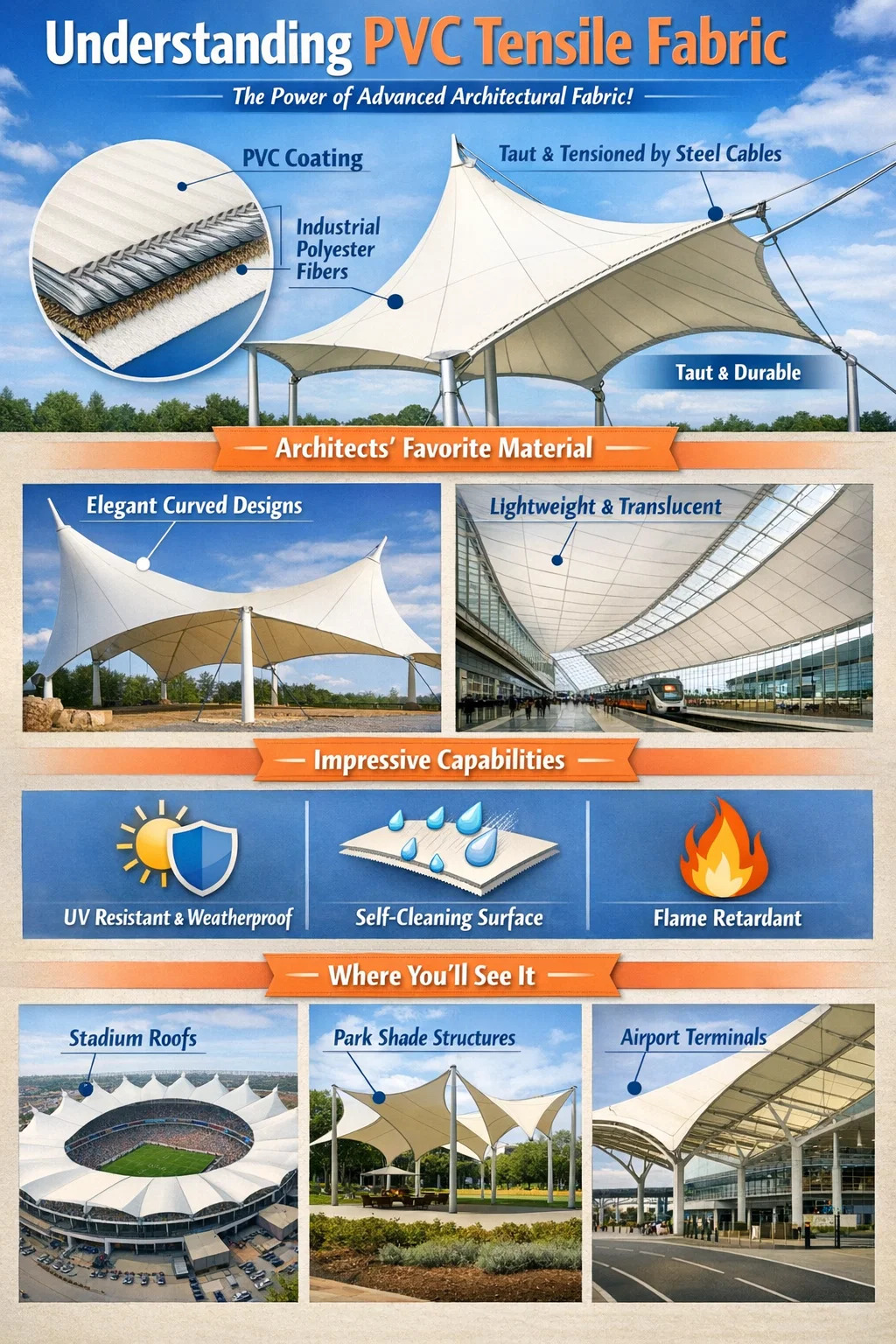
It's called "tensile" fabric because it is tightly stretched by steel cables or supports during installation.
Taut like a drumhead: Unlike ordinary curtains that hang loosely, it is stretched taut like a drumhead. This taut state allows it to withstand strong winds and even heavy snow.
High-strength core: Its base fabric usually uses very strong industrial polyester fibers, woven extremely densely, ensuring that it will not tear or deform when subjected to strong tension.
2. Why do architects like to use it?
This material brings unlimited possibilities to architecture.
Versatile shapes: It can be stretched into saddle shapes, tent shapes, or various elegant curves. You will often see these artistic shapes in stadiums, open-air theaters, or high-end parking structures.
Very lightweight: Compared to reinforced concrete, PVC tensile fabric is very light. This means that the steel structure supporting it can be very simple, saving a lot of building materials.
Good light transmission: Although it is a coated fabric, it can filter out harsh direct sunlight, filling the interior space with soft natural light, so that artificial lighting is not even needed during the day.
3. What are its impressive capabilities?
As a material that withstands the elements outdoors year after year, its basic performance is very solid.
Resistant to wind and sun: The surface is coated with a special protective layer that reflects most of the ultraviolet rays, preventing the material from yellowing or becoming brittle.
Self-cleaning: Many high-end PVC tensile fabrics have a very smooth surface. Rainwater forms droplets that roll off, carrying away surface dust, so it always looks clean.
Fire safety: This material contains flame-retardant components during production. In case of open flames, it usually only melts slowly and does not burn violently.
4. Common Application Scenarios
You may have seen it in these places:
Large venues: Such as the roofs of stadium grandstands, covering a huge area but appearing visually lightweight.
Landscape shading: Uniquely shaped sunshades in parks, and streamlined canopies above commercial streets.
Transportation hubs: Many modern high-speed train stations and airport entrance passages utilize this aesthetically pleasing membrane structure.
 Previous


