


 English
  Español
 русский
News
Content
- 1 What Is Tensile Fabric Used For? A Direct Answer
- 2 Commercial and Retail Architecture
- 3 Sports Stadiums and Recreation Facilities
- 4 Outdoor Events and Temporary Structures
- 5 Transport Infrastructure: Airports, Rail, and Bus Terminals
- 6 Industrial and Agricultural Applications
- 7 Façade Cladding and Sun Shading Systems
- 8 Comparing the Main Tensile Fabric Materials
- 9 Key Technical Properties That Define Performance
- 10 Emerging and Specialised Uses of Tensile Fabric
- 11 Sustainability Considerations in Tensile Fabric Specification
- 12 Frequently Asked Questions
What Is Tensile Fabric Used For? A Direct Answer
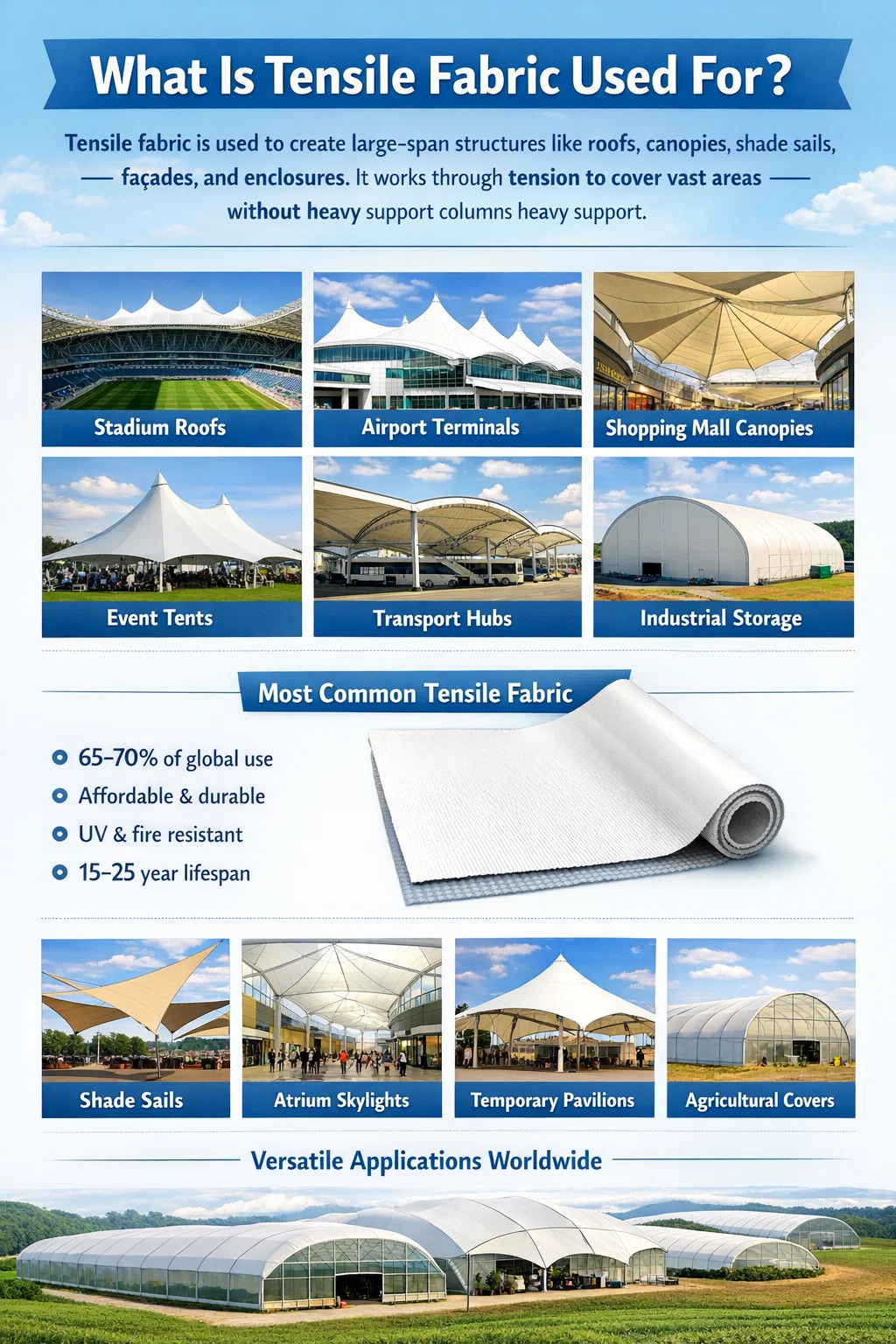
Tensile fabric is used to create large-span architectural structures — roofs, canopies, shade sails, façades, and enclosures — that combine structural strength with lightweight flexibility. Unlike conventional rigid roofing materials, tensile fabric works by distributing load through tension rather than compression, which means it can cover enormous areas without heavy support columns or thick framing. In practice, you will find tensile fabric on sports stadiums, airport terminals, shopping mall canopies, open-air event venues, car parks, theme parks, and even bridge walkways around the world.
PVC tensile fabric is by far the most widely specified material in this category. It accounts for roughly 65–70% of all architectural membrane projects globally, according to industry data compiled by the European Tensile Structure Association. Its dominance comes from a combination of affordability, UV resistance, fire performance, and the availability of consistent large-format rolls suitable for computer-controlled cutting and welding.
The sections below break down every major application category, explain which fabric specifications matter in each context, and compare the key material types so you can match the right product to your project from the outset.
Commercial and Retail Architecture
Shopping centres and high-street retail environments were among the first sectors to adopt tensile membrane architecture at scale, and they remain one of its largest markets today. The reasons are straightforward: a dramatic tensile canopy draws foot traffic, provides covered outdoor space that extends the usable retail floor plan, and does so without the planning complexity of a permanent roofed extension.
Entrance Canopies and Covered Walkways
Entrance canopies are probably the single most common tensile fabric application in retail. A well-designed canopy creates a clear visual signal for the entrance, protects customers from rain and sun during peak queuing periods, and provides a surface for integrated LED lighting or branded graphics. PVC tensile fabric with a lacquered top coat is the standard specification here because it is straightforward to print, resistant to cleaning chemicals used in retail environments, and achieves the flat, taut appearance that looks professional over time.
For covered walkways connecting car parks to mall entrances, engineers typically specify a fabric with a breaking strength of at least 4,000 N per 5 cm strip to handle wind uplift in exposed positions. Projects such as the covered walkway system at Westfield Stratford City in London used PVC-coated polyester membrane rated to these standards across spans of up to 18 metres without intermediate columns.
Atrium Roofing and Interior Skylights
Many enclosed malls use translucent tensile fabric as an atrium roof or skylight system in place of glass. ETFE (ethylene tetrafluoroethylene) foil cushions are one option, but coated tensile fabric with 10–15% light transmission is often preferred where diffuse, glare-free natural light is more desirable than full transparency. The fabric scatters direct sunlight, creating an even, shadow-free interior environment that is easier on the eye and reduces energy consumption from artificial lighting by up to 30% compared with opaque roofing.
Sports Stadiums and Recreation Facilities
The structural advantages of tensile fabric become most apparent at stadium scale. A tensile roof can cover a 40,000-seat grandstand with a steel cable-and-mast structure that weighs a fraction of an equivalent concrete or steel frame — and can be erected in a fraction of the time. This was demonstrated clearly at the Munich Olympic Stadium in 1972, which used a cable net with acrylic glazing, and has since been refined into modern PVC tensile fabric membrane roofs that are now the global standard for covered outdoor sports.
Stadium Roof Canopies
Modern stadium canopies face demanding multi-directional wind loads, UV degradation from decades of outdoor exposure, and the need to remain acoustically neutral so crowd noise carries naturally. PVC tensile fabric used in stadia typically carries a 25-year product guarantee and meets EN 13501-1 Class B fire performance. Fabric weight in these applications often ranges from 900 g/m² to 1,500 g/m², with higher weights used in exposed coastal locations where salt spray adds to the degradation load.
Notable examples include the Stade de France outside Paris, several Premier League football stadia in the UK, and the roofs of the Khalifa International Stadium in Qatar — all of which use welded PVC-coated membrane panels joined by high-frequency welding to form watertight, continuous roof surfaces spanning more than 50 metres.
Tennis Courts, Swimming Pools, and Multisport Halls
Tensile fabric is equally common in smaller recreation facilities. An inflatable tensile structure — an air-supported dome — can cover a full-size indoor tennis court for a fraction of the cost of a conventional steel building. These structures use double-skin PVC tensile fabric with an insulating air gap to achieve U-values suitable for year-round climate control in temperate regions. Deflation and storage during summer months is practical, making them popular with clubs and local authorities operating on constrained budgets. A typical 36 m × 72 m tennis dome costs roughly 40–60% less per square metre to install than an equivalent steel portal frame building.
Outdoor Events and Temporary Structures
The events industry is one of the highest-volume consumers of tensile fabric globally. Festivals, concerts, corporate functions, trade shows, and sporting events all rely on temporary tensile membrane structures to provide covered space quickly and at a cost that makes sense for short-duration use. The global temporary structures market was valued at approximately USD 3.2 billion in 2023 and continues to grow, driven by the expanding outdoor events calendar and increasing demand for high-specification hospitality structures at major events.
Marquees and Festival Tents
Traditional marquee canvas has been almost entirely replaced by PVC tensile fabric in professional event hire, because PVC-coated polyester is lighter to handle, stronger under wind load, more resistant to mould and mildew during storage, and far easier to clean between events. A standard clearspan marquee covering 20 m × 50 m will use between 1,800 m² and 2,200 m² of 680 g/m² PVC fabric across the roof, walls, and linings. The same structure can be erected in two to three days by a crew of eight and dismantled in a similar timeframe, making it commercially viable for events lasting as little as a weekend.
Tensile Shade Sails for Outdoor Hospitality
Shade sails — triangular or quadrilateral panels of tensioned fabric fixed to mast tips or anchor points — have become a staple feature of outdoor restaurant terraces, hotel pool decks, and beachside bars. They are quick to install, visually striking, and can be removed seasonally in climates with severe winters. In warm climates, HDPE mesh tensile fabric (high-density polyethylene) is favoured for shade sails because its open weave structure provides solar shading of up to 95% while still allowing air movement, keeping surface temperature below the shade as much as 10–15°C cooler than direct sun exposure. PVC tensile fabric is preferred when waterproof coverage is needed alongside shade.
Transport Infrastructure: Airports, Rail, and Bus Terminals
Transport hubs are high-footfall environments with demanding structural, acoustic, fire performance, and maintenance requirements. Tensile fabric has become the material of choice for covering departure halls, platforms, pick-up and drop-off zones, and pedestrian bridges in major transport infrastructure globally — precisely because it meets all these requirements simultaneously at lower self-weight than glass or metal sheet alternatives.
Denver International Airport's iconic white tent-like terminal roof — completed in 1994 and covering over 330,000 square feet — remains the most recognisable example of architectural tensile membrane in a transport context. It uses PTFE (polytetrafluoroethylene) coated fibreglass rather than PVC, because PTFE achieves a lifespan exceeding 30 years with minimal maintenance. However, for bus stations, railway platform canopies, and covered drop-off areas where budgets are tighter and spans are shorter, PVC tensile fabric is the practical standard — it performs well for 15–20 years with routine cleaning and is significantly less expensive per square metre to procure and fabricate.
Platform Canopies and Station Forecourts
Railway and metro platform canopies using tensile membrane structures have been completed at stations across Europe, the Middle East, and Asia-Pacific. The appeal is speed of construction — a tensile canopy for a 200 m platform can be fabricated off-site and installed in four to six weeks, with minimal disruption to train operations — and visual lightness, which keeps platforms from feeling tunnel-like. White or light-coloured PVC tensile membrane with 10–20% translucency maximises natural daylight on the platform while excluding rain.
Industrial and Agricultural Applications
Beyond prestigious architectural projects, tensile fabric does considerable practical work in industrial and agricultural contexts — areas where cost-per-square-metre and speed of erection matter far more than aesthetics.
Fabric Buildings and Industrial Storage
Clearspan tensile fabric buildings — structures using heavy steel arched frames covered with high-tenacity PVC tensile fabric — are widely used for storing bulk materials, housing vehicles and equipment, and providing sheltered workspace in mining, agriculture, ports, and construction. A 30 m × 60 m fabric building of this type can be erected in under two weeks and costs roughly 30–50% less per square metre than a conventional steel-clad metal building, with no requirement for internal columns interfering with storage or vehicle movement.
In cold climates, double-skin inflated wall panels provide insulation values that make fabric buildings suitable for temperature-sensitive storage. Grain, fertiliser, salt, and potash are all routinely stored under tensile fabric structures at agricultural and port facilities in Canada, Northern Europe, and Russia.
Greenhouse and Horticultural Covers
Specialist tensile fabrics designed for horticultural use — typically woven HDPE shade cloth rather than coated PVC tensile fabric — cover millions of hectares of crops globally. These fabrics regulate light intensity, reduce hail damage, control temperature, and in some systems maintain elevated CO₂ concentrations for accelerated growth. In regions such as Almería in Spain (often called "the sea of plastic"), polytunnel films and shade fabric cover more than 35,000 hectares of intensive vegetable production, making this one of the largest applications of tensile fabric materials in the world by surface area.
Façade Cladding and Sun Shading Systems
Tensile fabric is not restricted to overhead applications. Building façades increasingly use tensile membrane panels or tensioned mesh screens as external sun-shading elements, privacy screens, and decorative cladding. This application has expanded rapidly as architects look for ways to reduce solar heat gain in glazed office buildings without the visual heaviness of traditional metal louvre systems.
PVC tensile fabric and stainless steel wire mesh are the two dominant materials in façade shading. PVC is preferred where opacity or printability is needed — for instance, a corporate headquarters where the entire south façade is used as a branded visual surface. Wire mesh is preferred where maximum transparency and a high-tech aesthetic are priorities. In either case, the tensioned fabric or mesh is fixed to a secondary steel subframe and pre-stressed to remain taut and wrinkle-free across the panel, typically using corner plate or perimeter rope termination systems.
Façade shading membranes are engineered to reduce cooling loads. Studies of office buildings retrofitted with external tensile fabric shading screens consistently show energy savings of 15–25% in cooling-dominated climates, making this one of the fastest-growing segments of the tensile fabric market in the Middle East, Southeast Asia, and Southern Europe.
Comparing the Main Tensile Fabric Materials
Not all tensile fabrics are interchangeable. The table below summarises the four principal material types used in architectural and industrial tensile structures, with typical performance benchmarks and the application contexts where each performs best.
| Material | Base Substrate | Typical Lifespan | Approx. Cost (per m²) | Best Application |
|---|---|---|---|---|
| PVC-coated Polyester | Polyester yarn | 15–25 years | USD 15–45 | Events, canopies, stadia, industrial |
| PTFE-coated Fibreglass | Fibreglass yarn | 30–50 years | USD 80–150 | Airports, permanent stadia, landmark architecture |
| ETFE Foil | Fluoropolymer film | 25–35 years | USD 100–200 | Atria, botanical gardens, façades requiring transparency |
| HDPE Shade Mesh | HDPE monofilament | 8–15 years | USD 5–18 | Shade sails, agricultural covers, playground shading |
PVC tensile fabric dominates the market because it occupies a performance sweet spot: durable enough for permanent installations with a 15–25 year service life, economical enough for temporary and short-cycle applications, and technically straightforward to fabricate using HF welding equipment that is widely available worldwide. PTFE and ETFE command premium positions where permanence, fire performance Class A, or optical clarity are non-negotiable.
Key Technical Properties That Define Performance
Understanding what tensile fabric is used for requires understanding the technical properties that make it suitable for demanding environments. The following properties are measured and specified for every architectural tensile fabric project.
- Tensile strength: Measured in N per 5 cm strip in both warp and fill directions. Structural applications require a minimum of 3,000–5,000 N/5 cm; heavy-duty stadium roofs may specify 8,000–12,000 N/5 cm.
- Tear strength: Critical for determining resistance to puncture propagation. Typically measured by the trapezoid tear test; values of 400–800 N are standard for PVC tensile fabric used in roofing applications.
- Fire classification: EN 13501-1 is the standard in Europe; NFPA 701 in North America. Most architectural PVC tensile fabrics achieve Class B-s2-d0 or better, qualifying them for use in covered public spaces.
- Light transmission: Expressed as a percentage (0% = opaque, 100% = fully transparent). Architectural membranes range from 0% for blackout linings to 35% for translucent roof applications seeking natural daylighting.
- Weld strength: HF-welded seams in PVC tensile fabric should achieve at least 80% of the parent fabric's tensile strength. Seam quality is tested by peel and shear methods and is a critical quality control checkpoint during fabrication.
- UV stability: Accelerated weathering tests (Xenon arc or QUV) measure colour retention and tensile strength retention after equivalent years of UV exposure. High-quality PVC tensile fabric retains over 85% of tensile strength after 10 simulated years of UV exposure.
- Cold flexibility: Important for structures in northern climates. PVC tensile fabric for outdoor use should remain flexible and crack-resistant at temperatures down to at least -20°C.
Emerging and Specialised Uses of Tensile Fabric
Beyond the mainstream applications described above, tensile fabric continues to find new uses as material science and fabrication technology improve.
Tensile Fabric in Wastewater and Environmental Engineering
Floating cover membranes for wastewater lagoons, biogas digesters, and industrial effluent ponds are a fast-growing niche. These covers use chemically resistant coated tensile fabric to capture methane from digesters for energy recovery, prevent odour release from sewage lagoons, and exclude rainwater from evaporation ponds used in mining and food processing. The covers are engineered as tensioned membrane systems anchored at the lagoon perimeter, with gas collection points integrated into the membrane surface. Polypropylene-coated fabric and HDPE geomembrane are common in this context rather than standard PVC, due to the need for chemical resistance to hydrogen sulphide and ammonia.
Deployable Structures for Defence and Emergency Response
Military forces and humanitarian organisations use tensile fabric structures extensively for deployable hospitals, field command centres, and emergency shelter systems. These structures must be transported by vehicle or air freight, erected by a small team within hours, and meet performance standards for wind, rain, and in some cases blast overpressure. Lightweight PVC tensile fabric at 400–600 g/m² combined with aluminium arched frames is the dominant system in this space, balancing packable weight with sufficient structural performance for the intended service life of one to three years in field conditions.
Interior Design and Acoustic Panels
Tensioned fabric ceiling systems and wall panels are widely used in interior architecture for acoustic treatment, lighting diffusion, and concealing service infrastructure. Stretch ceiling systems — where PVC tensile fabric is thermally stretched over a perimeter track — cover millions of square metres of commercial and residential ceiling area globally each year. These systems allow lighting fixtures, sprinklers, and ventilation grilles to be integrated behind a flat, seamless fabric surface. In concert halls, convention centres, and recording studios, tensioned fabric baffles and reflectors are precisely positioned to tune room acoustics to the desired reverberation time.
Sustainability Considerations in Tensile Fabric Specification
Sustainability has become a significant factor in tensile fabric specification as architects, contractors, and building owners face increasing scrutiny over embodied carbon and end-of-life recyclability. The picture for PVC tensile fabric is mixed but improving.
PVC is a petroleum-derived material, and standard PVC coatings incorporate plasticisers — historically DEHP and other phthalates — that raise environmental and health concerns during manufacture and disposal. The European industry has largely transitioned to DINP and other non-phthalate plasticisers, and leading manufacturers now offer REACH-compliant formulations. End-of-life recycling remains challenging because separating the PVC coating from the polyester substrate is technically and economically difficult; most decommissioned PVC membrane currently goes to landfill or incineration in regions without specialist recycling infrastructure.
In contrast, PTFE-coated fibreglass has a lifespan of 30–50 years, significantly reducing replacement frequency and the associated material throughput. ETFE foil is fully recyclable at end of life through fluoropolymer recycling streams, which is one reason its use has grown in sustainability-focused projects. HDPE shade fabric is recyclable in standard polyolefin streams.
Regardless of material, the long service life of well-specified tensile fabric structures — and the significant reduction in structural steel or concrete required to cover large areas compared with rigid construction — means that the whole-life environmental performance of tensile membrane roofs is generally favourable. A tensile membrane covering a 5,000 m² sports facility uses roughly 70–80% less structural steel by weight than an equivalent conventional steel-framed roof, representing a significant saving in embodied carbon.
Frequently Asked Questions
What is the difference between tensile fabric and ordinary tarpaulin?
Architectural tensile fabric and commodity tarpaulin both use PVC-coated polyester as a base, but they differ substantially in specification. Tensile fabric used in structural applications is engineered to precise tensile and tear strength standards, tested for UV stability over accelerated weathering cycles, manufactured to tight dimensional tolerances for accurate cutting, and coated with lacquer or PVDF top coats that resist dirt, mould, and discolouration over 15–25 year design lives. Commodity tarpaulin is produced to no comparable standard and is not suitable for permanent structural use.
How long does PVC tensile fabric last outdoors?
15 to 25 years is the realistic service life for good-quality PVC tensile fabric in a permanent outdoor installation with routine cleaning. Premium-grade products with PVDF lacquer coatings from manufacturers such as Serge Ferrari, Mehler, or Saint-Gobain Performance Plastics are typically warranted for 10–15 years and realistically perform well beyond that in non-coastal, moderate UV environments. Coastal or desert installations with high salt, UV, and temperature cycling may experience faster degradation and should be scheduled for replacement inspection at 12–15 years.
Is tensile fabric waterproof?
Yes, coated tensile fabric — including standard PVC tensile fabric — is fully waterproof when the membrane panels are correctly joined by welded seams. The weld seam is the critical point; improperly welded or aged seams can allow water ingress. Mesh tensile fabrics (such as HDPE shade cloth) are not waterproof and are designed exclusively for shade and visual screening applications.
Can tensile fabric be used for permanent buildings?
Yes, and thousands of permanent buildings use tensile fabric as the primary roof or wall cladding material. Airports, sports stadia, convention centres, transit stations, and industrial storage buildings all use tensile membrane as a permanent structural element. The key requirement is correct structural engineering, appropriate fabric specification for the load and exposure conditions, and a maintenance programme including periodic cleaning and inspection of seams and connections.
What industries use the most tensile fabric?
By volume, the largest consumers of tensile fabric are the events and temporary structures industry, followed by commercial architecture (retail, hospitality, corporate), sports and recreation, transport infrastructure, and industrial storage. Agriculture uses very large surface areas of tensile-related materials (shade cloth and polytunnel film) but these are typically lower-specification products than those used in engineered structures.
 Previous


