


 English
  Español
 русский
News
Home / News / Industry News / Tarp Anchors: How to Select, Install, and Secure Them on Any Ground Type
Content
Tarp Anchors: How to Select, Install, and Secure Them on Any Ground Type
The best tarp anchor is the one that matches the ground condition beneath the tarp and spreads wind load across the full perimeter. Most anchoring problems are not solved by buying stronger hardware; they are solved by choosing the right holding principle: buried resistance, ballast, or a bolted connection. Everything else is geometry, spacing, and how the tarp itself transfers force to the anchor.
A lightweight stake can hold a camping tarp on a calm evening, but the same stake becomes the weak link when wind loads scale up. On a 12 ft x 16 ft PVC tarpaulin, the total wind load is roughly 790 lb at 40 mph and about 1,770 lb at 60 mph, using the simplified ASCE 7 wind pressure expression. One or two corner stakes cannot carry that load; it has to be distributed over a row of anchors.
| System | Failure mode | Typical resistance in firm soil | Best use |
|---|---|---|---|
| Light tent stake | Rotates through soil under low-angle pull | 30 to 60 lb direct withdrawal | Small tarps, calm conditions |
| Corkscrew earth anchor | Helix must shear a soil column | 400 to 1,200 lb depending on size | Medium to large tarps in soil |
| Sandbags or ballast | Slides when load exceeds friction | About 150 lb lateral per 30 lb bag on concrete | Hard surfaces with no soil |
| Bolt-down floor anchor | Anchor stays fixed; strap or grommet is the limit | Limited by strap and grommet rating | Concrete, decks, vehicle beds |
This comparison explains the logic used throughout this guide: soil anchors for penetrating ground types, ballast for hard surfaces, and bolted anchors for permanent structures. Anchor selection always starts from the ground, not from the tarp.
Tarp anchors come in more shapes than most users expect, and the names in hardware stores do not always make the differences obvious. These five families cover the standard range of field setups.
A corkscrew anchor is turned into the ground with a handle or a steel bar. Its helix is the working part: once fully seated, the anchor must shear a cone of soil before it can move. A 6 in size works for small tarps in firm grass; 10 to 12 in versions are the most dependable choice for medium and heavy coated PVC tarps in exposed locations.
Dogbone stakes and cable stakes are longer pins that accept a rope or strap through a loop at the top. They install and remove quickly, but they rely on surface friction and a small amount of soil compaction. When a pull comes from a low angle, a dogbone stake rotates and works loose. Use them only for low-load tarps, tents, and very short-term covers.
Where the ground is concrete, asphalt, compacted gravel, or rock, you cannot bury anything. Ballast anchors replace soil grip with mass and friction. A single 30 lb sandbag on clean concrete resists roughly 150 lb of horizontal pull when you apply a typical friction coefficient of 0.5. Stacked sandbags or water-filled ballast tubes increase this in proportion, and a rubber or fabric pad under the bags protects the tarp edge from abrasion.
Permanent or semi-permanent setups on wood decks, concrete aprons, and truck beds call for a floor anchor that is bolted to the structure with a steel plate or loop. The tarp strap then clips into the loop with a carabiner. In this configuration, the weakest point is the tarp grommet, which is the correct design target: the anchor is never going anywhere, so the product protects the fabric from overload.
A deadman is a buried object, such as a length of timber, a tire, or a fabric tube filled with sand, connected to the surface by a strap or cable. It is the traditional anchor for large field shelters and long-term covers. Because the strap exits the ground at an angle and the deadman sits below grade, it keeps the area clean and provides resistance that scales with the burial depth of the member.
| Anchor type | Best ground | Typical resistance | When to use |
|---|---|---|---|
| 6 in corkscrew | Grass, loam | 400 to 600 lb | Small to mid tarps up to about 100 sq ft |
| 12 in corkscrew | Clay, dense soil | 800 to 1,200 lb | 100 to 300 sq ft coated tarps |
| 18 in screw-in anchor | Heavy clay, gravelly soil | 1,500 to 2,500 lb | Permanent field structures |
| Dogbone stake | Grass, sand | 100 to 200 lb | Camping tarps, short-term use |
| 30 lb sandbag | Concrete, asphalt | About 150 lb lateral | Hard surfaces with no soil |
| Bolt-down floor anchor | Wood, concrete | Limited by strap and grommet | Decks, vehicle beds, semi-permanent sites |
Wind pressure on a flat tarp can be estimated with the simplified ASCE 7 wind pressure expression, where pressure in pounds per square foot equals 0.00256 multiplied by the square of the wind speed in miles per hour. This is the same base calculation used in many temporary structure and canopy tie-down estimates, and it is accurate enough for anchor planning.
| Wind speed (mph) | Pressure (psf) | Total load on 12 x 16 tarp (lb) |
|---|---|---|
| 20 mph | 1.02 psf | 196 lb |
| 40 mph | 4.10 psf | 786 lb |
| 60 mph | 9.22 psf | 1,770 lb |
| 80 mph | 16.38 psf | 3,145 lb |
The total load is the pressure multiplied by the projected area of the tarp. To see what each anchor must hold, divide the total by the number of loaded anchor points, then add a factor of two or more for corner anchors and gusts. Wind rarely hits a single flat face at one perfect angle, which is exactly why anchors on the windward edge fail first.
Anchor spacing is a practical compromise between cost and safety. The windward edge needs a tighter pattern, the side edges get additional anchors near the corners, and the leeward edge needs the least support because simple airflow presses the tarp downward there.
| Tarp size | Approximate area | Suggested anchor count | Spacing guide |
|---|---|---|---|
| 6 x 8 ft | 48 sq ft | 6 to 8 anchors | 3 to 4 ft along edges |
| 10 x 12 ft | 120 sq ft | 8 to 12 anchors | 3 ft windward, 5 ft leeward |
| 12 x 16 ft | 192 sq ft | 12 to 16 anchors | 3 to 4 ft along windward side |
| 20 x 30 ft | 600 sq ft | 20 to 30 anchors | Add intermediate straps and center rows |
If a tarp has reinforced hems or a sewn perimeter loop, you can add intermediate grommet straps and increase the anchor count beyond the table at any time. Corners always get a dedicated anchor, and corner grommets on coated PVC tarps should be backed by a doubled hem or a load-spreading washer.
A repeatable installation procedure is what separates a well-anchored tarp from one that fails after the first windy night.
The amount of tension you can apply depends on the coated fabric itself. Heavier PVC-coated tarpaulins have denser woven cores and thicker coating layers, so their corners and hems carry higher pre-tension without distortion; lighter film structures need a softer hand.
For a heavy tarp, typically a 650 to 900 gsm knife-scraped PVC tarpaulin, you can safely use 12 in corkscrew anchors or longer and tighten with ratchet straps. The reinforced hem and corner patches spread the pull, and the anchor can be tensioned firmly without tearing the material. For a factory-built option, heavy knife-scraped PVC tarpaulin sheets are designed with reinforced edges that suit permanent or semi-permanent anchoring.
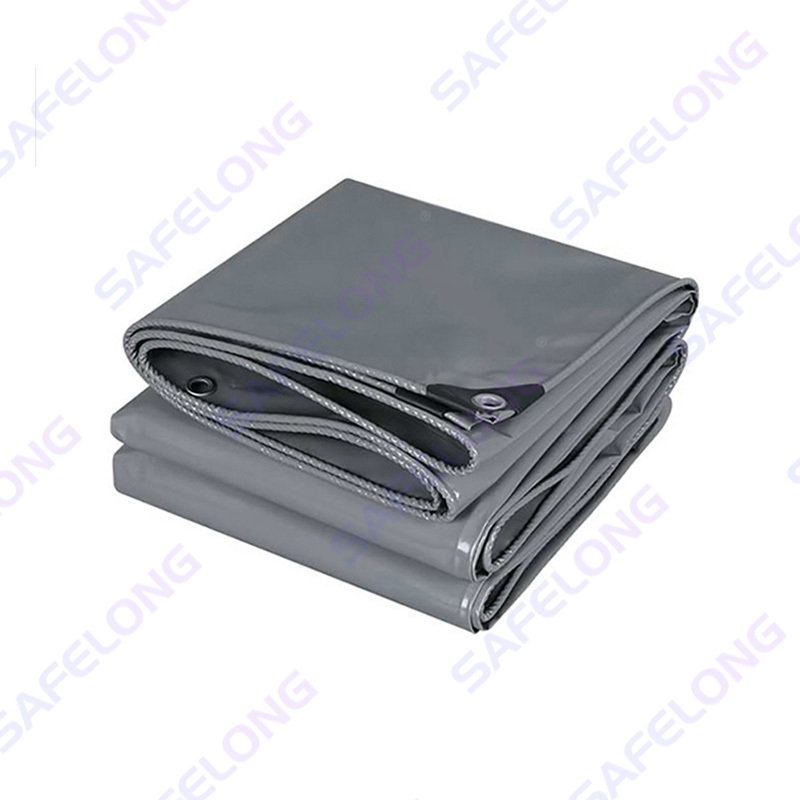 Wholesale Knife-scraped tarpaulin Suppliers, Factory - Jiangsu Sulong Eco-TechnoJiangsu Sulong Eco-Technologies Co., Ltd is a China Knife-scraped tarpaulin suppliers and factory, We specialize in wholesale Knife-scrap...View Product →
Light film tarpaulins, often in the 120 to 220 gsm range, stretch when they absorb heat and can pull loose from small grommets if tensioned too hard. Use 8 to 10 in corkscrew anchors at wider spacing, keep the tension moderate, and check the grommets for elongation after the first day. For applications where weight matters more than strength, our film tarpaulin is a reasonable match for light anchoring patterns.
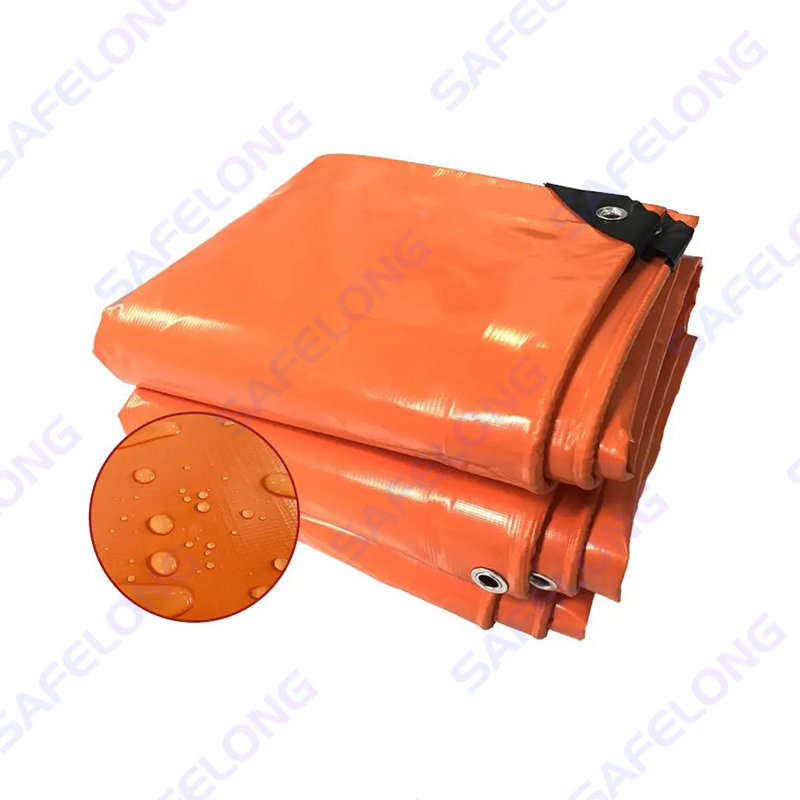 Wholesale Film Tarpaulin Suppliers, Factory - Jiangsu Sulong Eco-Technologies CoJiangsu Sulong Eco-Technologies Co., Ltd is a China Film Tarpaulin suppliers and factory, We specialize in wholesale Film Tarpaulin sale....View Product →
Camouflage tarps and privacy fence tapes are usually mounted between posts rather than laid flat on the ground, so the anchor system shifts from ground stakes to post or floor anchors. The fabric still needs a reliable grommet line and even tension along the post spacing. If you are building this type of cover, our camouflage waterproof cloth shows a typical mid-weight PVC product range for such screening applications.
 Wholesale Camouflage Waterproof Cloth Suppliers, Factory - Jiangsu Sulong Eco-TeJiangsu Sulong Eco-Technologies Co., Ltd is a China Camouflage Waterproof Cloth suppliers and factory, We specialize in wholesale Camoufl...View Product →
For tensioned fabric products more broadly, the same anchoring rules apply whether you are fastening a canopy or a curved tensile membrane. A product-focused overview can be found in our buyer's guide to PVC tensile fabric.
If you want the factory-side picture of tarp construction, including hem types, seam construction, and grommet patterns, our introduction to PVC tarpaulin covers covers the finishing choices that affect where and how you anchor.
The same low-tolerance thinking applies in our field installation work. For an example of tensioned fabric components under real project pressure, see the Melbourne Metro rail project installation experience.
Use a corkscrew or earth auger anchor that is at least 12 in long, because short stakes have almost no holding surface in dry sand. Angle the anchor so the pull lines up with the shaft, and compact the sand around the top after installation. For a short-term light tarp, a wide T-shaped sand stake is a better choice than a thin peg.
Plan for 8 to 12 anchors in a moderate wind zone. Place the densest spacing on the windward edge, put one anchor at each corner, and use intermediate anchors every 3 to 5 ft along the sides. For higher wind exposure, add a second row of anchors and a center ridge strap.
Yes, use sandbags or water-filled ballast bags. A 30 lb sandbag gives about 150 lb of horizontal resistance on clean concrete at a friction coefficient of 0.5. Place a protective pad under the bag so the fabric is not worn by the bag surface, and use enough total weight to cover your calculated wind load.
Reduce stress at the grommet with a load-spreading washer, a flat metal plate, or a short section of webbing looped through the grommet. Avoid attacking the grommet directly with the hook of a ratchet strap, and keep the pull off the corner by connecting the strap to the hem rather than only to the metal ring.
Use a ratchet strap with low-stretch webbing for controlled, even tension. Rope stretches, loses tension in heat, and can slip at the knot. If rope is the only option, use a taut-line hitch for a temporary hold and retie it after heavy rain or strong wind.
Corkscrew anchors can stay in the ground, but freeze-thaw cycles in wet clay can heave them upward over time. If the tarp comes off for the season, back the corkscrew out halfway and mark its position, or leave a strap attached so you can find it and re-drive it in spring. Ballast anchors should be emptied and stored before water inside them freezes.
If you have any questions, please fill out the contact form at the bottom of the page and contact us.
You agree to Sulong Terms and Privacy Policy.

No.9 Filter Material Industry Park, Funing, China (Factory)
Unit 2, 15#-405, Kuanglu Community, Gulou District, Nanjing, China (Office)

+86 15724842588

+86-0515-68589566

+86-0515-68589566

info@safelong.net

